Technology
The interview was hiring's last blind spot. Introducing Tomo, Maki's interview intelligence platform.
Interviews are the most subjective step in hiring. Tomo, Maki's interview co-pilot, turns every interview into structured, defensible evidence. Here is why.
July 2, 2026
Juliette Santelmo
Finance runs on data. Sales runs on data. Marketing runs on data. Hiring still runs on a CV and a gut feeling, and nowhere is that more true than in the interview.
Every other enterprise function was rebuilt around software that does the work, not just files it. Hiring got software that stores candidates and moves them from stage to stage, but was never able to judge them. So teams patched every gap with a separate point tool, and after all of it, the most important decision still came down to what one person half-remembers from a conversation.
We think that era is ending. This is the story of how hiring went end to end, why the interview was the piece we saved for last, and what we built to close the loop: Tomo, an interview intelligence platform that works as a co-pilot for the people who actually run interviews.
How we got here: 40 years of software that files but does not judge
The ATS was a real step forward. It gave companies one place to keep every candidate and move applications along. But it was built to store applications, not to judge them. That single design choice shaped the next four decades.
Because the ATS could not judge, every part of the funnel that required judgement got outsourced to a bolt-on tool. An assessment vendor here. A video interviewing product there. A scheduler. A reference-check tool. Recruiters ended up running six or seven disconnected systems to run one process, none of them talking to each other, none of them carrying memory from one hire to the next. And at the end of that expensive stack, the decision still came down to a CV scan and a hunch.
AI is the first technology that lets the system actually do the work instead of just storing the data. That is the shift underneath everything Maki builds. Not a faster horse. A different machine.
Why one better stage is not enough: the case for end-to-end hiring
The instinct across the market has been to fix one stage at a time. A smarter screener. A slicker scheduler. A better video interview tool. Each of those helps a little, and each of them leaves the same problem in place: the signal never travels. What a candidate demonstrated in a skills screen is invisible by the time they reach the final interview. The rubric used at the top of the funnel bears no relationship to the questions asked at the bottom. Every stage starts from scratch, and the final decision is made with almost none of the evidence the process already produced.
End-to-end hiring is the answer to that. Not more tools, but one intelligence layer that plugs into the ATS you already run and makes every stage think, with the signal from each stage compounding into the next. The ATS stays. The recruiter stays. Everything between them gets intelligent.
Concretely, that layer runs across the funnel any talent leader already recognises:
- Intake turns a hiring manager's brief into a calibrated role, a scoring rubric, and a clear definition of success, instead of a copy-pasted job description.
- CV screening (Skills Screening) evaluates every applicant on the skills that predict performance, in minutes, scored the same way every time. No qualified candidate lost to a keyword.
- Phone screening (Voice Screening) runs an adaptive conversational screen 24/7, so candidates are assessed on their schedule, not the recruiter's calendar.
- In-depth assessment (Deep Assessment) brings full, science-validated rigour to your high-stakes roles, through long-form structured assessments on the dimensions that actually predict on-the-job success.
- Scheduling (Orchestration) books interviews automatically and keeps the funnel moving, so strong candidates do not cool off waiting.
- The human-led interview (Interview Co-pilot) is the final human step, and until now, the one stage that stayed completely manual.
Five of those six stages had a data layer. One did not. The interview was the blind spot.
The human-led interview: the highest-stakes, least-instrumented step in hiring
Here is the uncomfortable truth about interviews. They are the most subjective, inconsistent and biased part of the entire process, and they carry the most weight in the final decision. Outcomes depend on who happens to be asking the questions, how carefully that person listens, which answers they write down, and what they still remember by the time the debrief happens.
It gets harder still because most of these interviews are not run by full-time recruiters. They are run by hiring managers and colleagues who interview a handful of times a year, with no structure to lean on and no time to build one. The remedy has been known for decades: the US Office of Personnel Management's guide to structured interviews sets out the standard, with every candidate asked the same job-related questions and rated on the same scale. Yet without a system to hold that structure in the room, most interviews drift back into conversation. Two interviewers speaking to the same candidate can walk away with opposite conclusions, because they asked different questions and anchored on different moments. A great answer given in minute two is forgotten by minute forty. The notes, when they exist, are fragments scattered across notebooks, email threads and memory. And when a rejected candidate, a works council or a regulator asks how a hiring decision was reached, the honest answer is often that nobody can fully reconstruct it.
This is not a small gap. It is the gap. The interview is where the offer decision is made, and it was running on the least reliable inputs in the whole funnel. Fixing screening and assessment while leaving the interview manual is like instrumenting the entire flight and then landing the plane with your eyes closed.
That is the rationale for building an interview layer, and it is why we saved it for the end. Everything upstream produces structured evidence. The interview needed to join that system, not sit outside it.
Introducing Tomo: your interview co-pilot
Tomo is Maki's interview co-pilot. In market terms it is an interview intelligence platform: software that plans, captures and structures live interviews so the evidence they produce is consistent and reviewable. In practical terms it is the layer that finally brings structure, completeness and fairness to the interview, without adding a single step to the interviewer's job.
Most interviewers are trying to hold a real conversation and take notes at the same time. One of those always suffers. Tomo removes the trade-off. Here is what Tomo does today.
Before the interview: the plan
Every interview starts from a structured plan built by role and competency, so each candidate for a role is asked about the same things, and the interview measures what the job actually requires, not whatever happens to come up in the moment.
During the interview: Tomo in the room
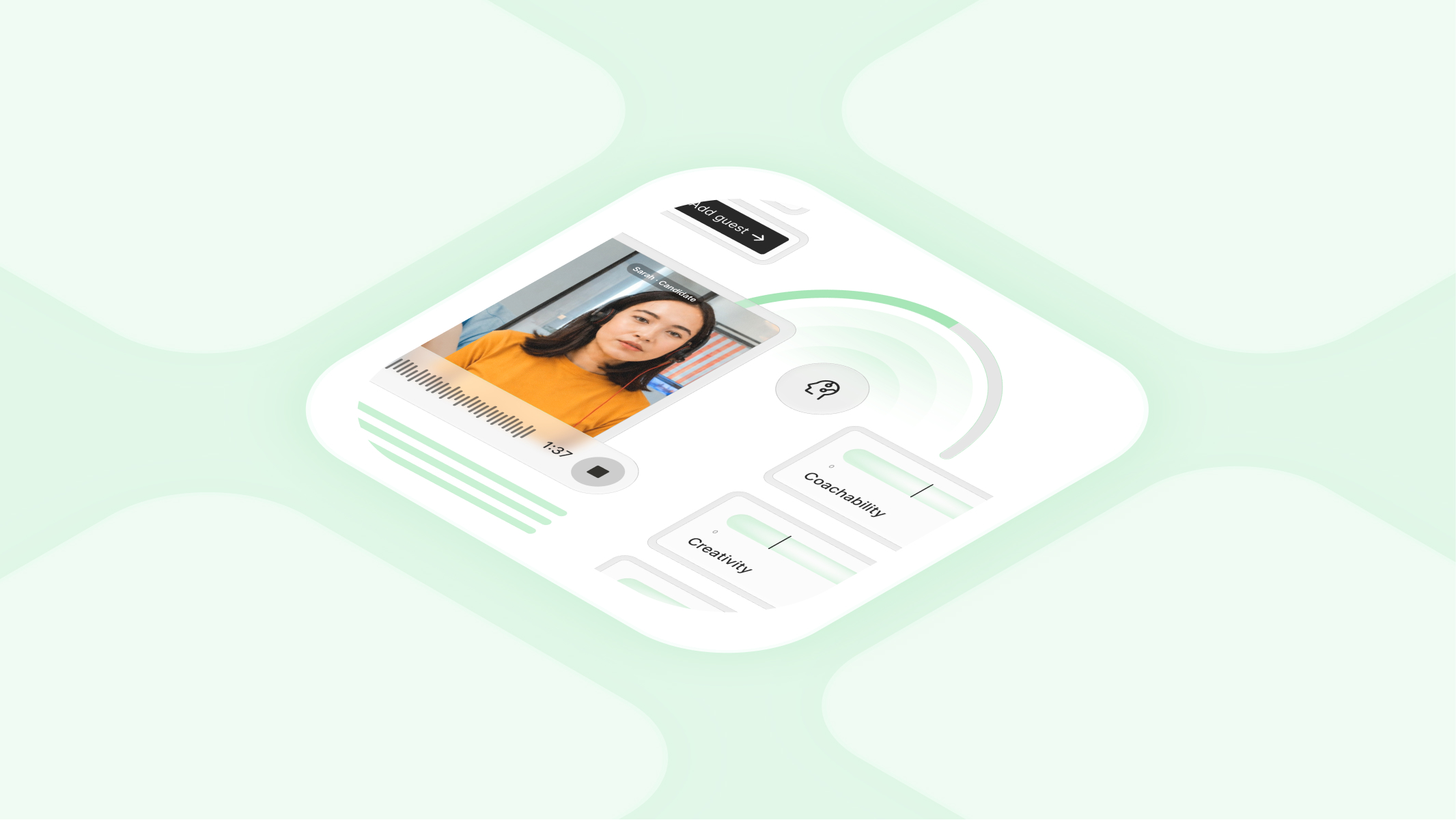
Tomo joins on Zoom, Teams or Meet when invited, and captures the full conversation. It transcribes live and takes structured notes against the plan, so the interviewer can stay present with the candidate instead of splitting attention between listening and writing.
As the conversation moves, Tomo keeps the plan live in front of the interviewer, flags when time is running short on a competency, and points out when the candidate says something worth exploring, so the interviewer can give every candidate the room to show their best.
After the interview: the candidate card
Everything lands on the candidate's profile inside Maki:
- an AI report, shaped to how your team works and pushed straight into your ATS, so nothing is lost to a notebook or an inbox
- the evidence for each competency, backed by the exact transcript behind it
- the full transcript
- plan coverage: what was explored, and what was skipped
- insights you can coach against
The point is not to replace the interviewer. The point is to free them to do the human part, reading the person, building the relationship, making the call, while Tomo takes the admin, holds the structure and keeps everything transparent. The interviewer stays on the candidate. So every candidate gets the room to show the best of what they have got.
How Tomo closes the loop, and why structure beats a smarter recorder
Tomo is not a standalone note-taker. Because it lives inside Maki, the interview stops being an island. Everything Tomo captures sits on the candidate card next to the signal from screening and assessment, and feeds the final hire decision with the evidence attached. The last, most important step finally joins the same system as every stage before it.
This is where Maki is different from the wave of generic AI meeting recorders now being pointed at interviews. A general-purpose transcriber just records the same unstructured, inconsistent conversation, faster. It does nothing about the reason interviews go wrong in the first place. Tomo is purpose-built for hiring, and the difference is structure.
That structure is where the science lives. Maki's assessment science shapes the interview plan itself: which competencies actually predict success in the role, which behaviours to listen for, which questions to ask. Then Tomo keeps that plan live in the room and organises every observation as evidence against those competencies, tied to the exact words in the transcript. So instead of a blank page and a debrief built on memory, every interviewer, including the manager who interviews twice a year, runs the same validated structure, and every conclusion traces back to something the candidate actually said.
The defensibility comes from structure and verbatim evidence, backed by the same security, bias audit and AI Act controls that cover every other Maki agent. That is what makes the interview as rigorous and as auditable as every stage before it, and it is what separates an interview intelligence platform from a recorder with a summary button.
The bigger picture: hire better, not just faster
Tomo is the last piece of a deliberate design. One system, plugged into the ATS you already run, making every stage from intake to hire recommendation intelligent, with the science underneath to make every decision defensible and the connective layer to make the signal compound. The ATS stays. Your recruiters stay. What gets replaced is the manual, inconsistent, undefendable work that used to sit between them, so your people spend their time on judgement and relationships instead of admin, and your whole company hires better, not just faster.
The outcomes follow from that logic. Up to 90% of screening and assessment work automated. Time to hire cut by 3x. Early-tenure turnover down by up to 25%. A 98% candidate NPS. All of it deployed in 60+ countries, signed off by 80+ works councils and employee committees, and built enterprise-ready from the start.
Hiring is finally running on data. Including the interview.
See Tomo on your own interviews
The interview was the last blind spot in hiring. It does not have to be. See how Tomo, the interview intelligence platform built into Maki, turns your interviews into structured, defensible evidence, connected to the rest of your funnel.
Book a demo.

See what Maki Agents can do for you