Technology
Multi-skill interview assessment: how Mochi scores several skills from one answer
Candidates should never have to repeat themselves to prove what they already showed us.
November 9, 2026
Ben Chino

In short
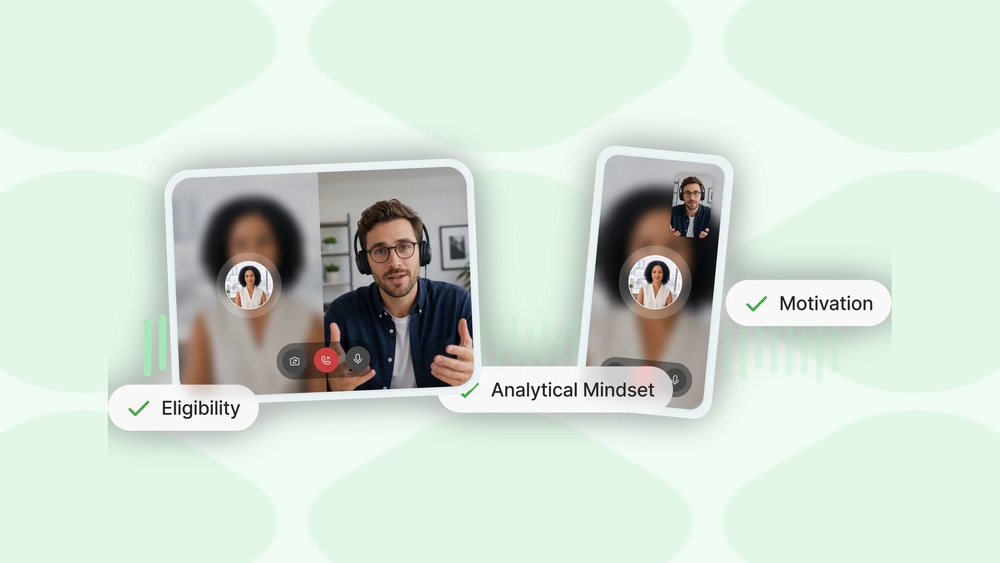
Overlay skills let Mochi score several competencies, like communication or language ability, from a single interview answer instead of asking a separate question for each one. Candidates answer once, interviews get shorter, and recruiters get a fuller, more accurate picture of what someone can actually do.
For decades, hiring has run on a quiet bargain: the more you want to know about a candidate, the longer you make them talk. We think that bargain is broken. With overlay skills, Mochi reads a single answer through several lenses at once, so candidates spend less time proving themselves and recruiters walk away with more signal than before.
Ask any experienced recruiter what they learned from a good first conversation and you'll get a long answer. They'll tell you how the candidate handled a tricky question. They'll also tell you how clearly they explained themselves, how they talked about their old team, whether they seemed at ease in the language the job requires.
None of that came from a dedicated question. It came from listening.
Assessment, for most of its history, has worked the other way around. One question, one skill, one score. If you wanted to measure four things, you asked four sets of questions, and the candidate paid for every one of them in time and patience.
We set out to build an interview that listens the way that recruiter does.
Why do interviews keep getting longer?
Most screening processes grow by addition. A hiring manager asks for teamwork, so a teamwork section appears. The role needs Italian, so an Italian section follows. Each request is reasonable on its own. Together, they turn a fifteen-minute conversation into a gauntlet.
The structure made sense when assessment meant paper tests and human graders. A grader could only score what a question was designed to capture, so every skill needed its own question. That logic quietly carried over into digital assessments, then into AI interviews.
The cost lands on the candidate. They answer a question about customer service in Italian, then answer more questions in Italian just to prove they speak Italian. It feels repetitive because it is.
In high-volume hiring, repetition is expensive. Every extra minute is a chance for a strong candidate to close the tab. Some of our customers went as far as running two separate screenings for the same role: one for the core skills, one for the language. Two invitations, two completions, two chances to lose someone good.
How does multi-skill interview assessment work?
A real answer is never about one skill. When a candidate describes the day they calmed down a furious customer, they're showing you their judgment under pressure. They're also showing you how they structure a story, how they speak about other people, and how comfortably they move through the language.
Traditional assessment
Mochi with overlay skills
How it's built
One question, one skill, one score.
A natural conversation, built around the skills that need dedicated questions.
Adding a skill
Want to measure four things? Ask four sets of questions.
A recruiter layers on additional skills that ask nothing of their own.
The rest of the answer
Hears one thing and throws the rest away.
Each skill is an independent lens, reading the candidate's answers across the whole interview or in the moments the recruiter chooses, and scoring them against its own criteria.
Outcome
The candidate pays for every skill in time and patience.
One story, scored for what the candidate did and how they said it. The scores never blur together.
The candidate answers once. The recruiter sees every dimension.
Does a shorter interview mean a weaker assessment?
No. Overlay skills are one of the rare cases where candidate experience and assessment quality improve at the same time, instead of trading off against each other.
For the candidate
The interview gets shorter and feels more human.
The questions that existed only to feed a score disappear. A bilingual customer advisor no longer sits through a separate language test: they simply have the interview in the language they'll use on the job.
For the recruiter
The picture gets fuller.
Every overlay skill appears in the report with its own score, alongside the skills that had dedicated questions. It counts in the overall result, it can carry a knock-out threshold, and it flows into the ATS like any other skill. One screening now delivers what used to take two.
Shorter doesn't mean less rigorous, because length was never what made an interview predictive. Structure is. When researchers went back over decades of hiring studies, the result surprised a lot of people:
“Sackett et al.’s (2022) work … revealed that structured interviews may in fact be the strongest predictor of job performance.”
Society for Industrial and Organizational Psychology, Is cognitive ability the best predictor of job performance?
Overlay skills keep that structure intact. Every skill is still scored against its own criteria; it just no longer needs its own questions to get there.
The signal itself often improves, too. A dedicated language question invites a rehearsed answer. Language assessed across a whole interview captures how someone speaks when their attention is on the substance of the conversation, under a little pressure, thinking on their feet, much closer to how they'll use the language with a real customer on a busy Monday morning.
The same principle extends beyond language. Some skills, like communication, show up in every answer. It never made sense to measure them in a box of their own.
How do we validate each overlay skill?
More signal is only valuable if every signal holds up. Getting more out of each answer raises the bar on how carefully we read it.
Each lens is built and validated by our Science team before it scores a single real candidate. Language proficiency goes through the same process as every competency grid we ship: a dedicated evaluator, tested against its own validation dataset. Until a lens has earned that, it doesn't produce a score.
Every score also shows its working. On the report, each overlay skill states exactly where it was scored from: specific moments in the conversation, or the interview as a whole. A recruiter or hiring manager reviewing a result can see what it rests on, which is what human oversight of AI in hiring should look like in practice.
We also kept the rules simple. Each skill has one clear source. If a recruiter changes where a skill is scored from, results before and after the change are kept apart, so nobody compares numbers that measured different things.
What does this change about how we design interviews?
The principle behind overlay skills is simple, and it shapes how we build everything at Maki: ask candidates only what you need to ask, and learn everything you can from what they tell you.
That changes the question hiring teams ask when they design an interview. It used to be “what else should we test?”, with each answer adding length. Now it can be “what else can we learn from this conversation?”, and the answer costs the candidate nothing.
It's the same instinct behind skills-based hiring: stop asking people to prove themselves twice, and start trusting what they've already shown you.
We think this is where AI in hiring gets genuinely interesting. Automating the old process faster was the first step. The real opportunity is designing assessments that would have been impossible before: conversations that feel natural to the person having them, and still give recruiters a deep, multi-dimensional view of their potential.
The best recruiters have always listened this way. Now every candidate gets that kind of attention.
Key takeaways
- Interviews got long because every skill needed its own questions. That made sense for paper tests, not for AI that can listen to a whole conversation.
- Overlay skills let Mochi score several skills from one answer, each with its own evaluator and its own score.
- Candidates answer once, in a shorter and more natural interview. Recruiters get more signal, often a more authentic one.
Want to see an interview that asks less and learns more?
See how Mochi turns one conversation into a complete picture of a candidate.
Request a demoFAQ
What is an overlay skill?
A skill that Mochi scores from answers the candidate gives elsewhere in the interview, instead of through questions of its own. A recruiter can overlay it on the whole interview or on specific parts of it, and it carries its own score and its own validation.
Does it change the experience for the candidate?
Only by making it shorter. The conversation itself is the same, and candidates are told upfront that they're speaking with an AI interviewer and what the interview covers. Overlay skills don't add any new questions or steps.
Can any skill be scored as an overlay skill?
No. Each overlay skill, including language proficiency, goes through the same validation process as every competency grid Maki ships: built and tested by the Science team against its own dataset before it scores a real candidate.
Sources
Maki Product team. Society for Industrial and Organizational Psychology (SIOP), on Sackett et al. (2022). Page reviewed 3 November 2026.

See what Maki Agents can do for you